

The warm spring sun in Pokhara, cement dust in the air, and the sharp “krr-krr” sound of steel bars being cut. I stepped onto the construction site for the first time wearing a shiny new helmet, a gleaming safety vest, and the fresh confidence of my engineering degree. My head was full of bending moments, shear forces, and NBC codes. Little did I know I was about to attend a school that no university can certify. I was Unknow about construction site measurement mistakes or else in the field.
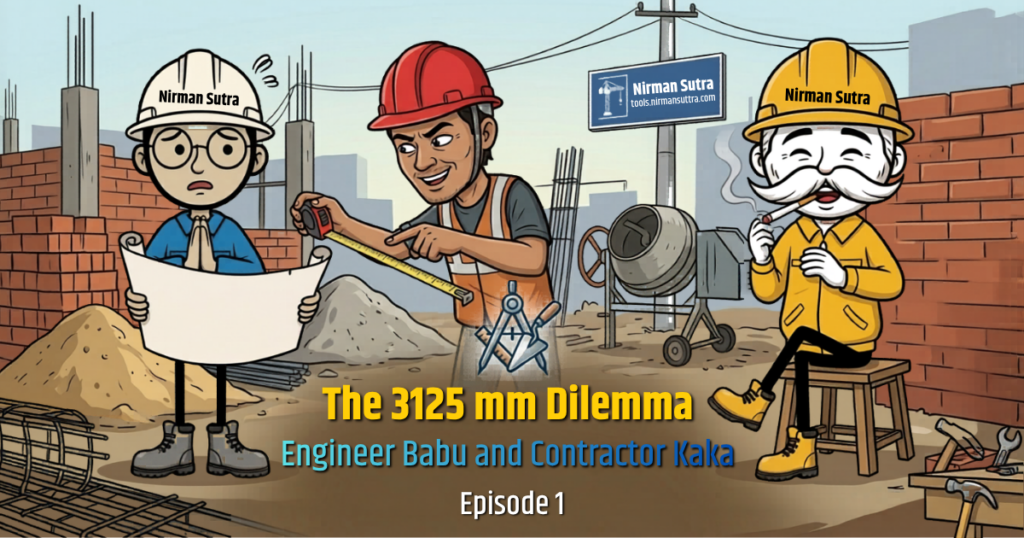
There, sitting on an old wooden chair with one leg crossed over the other and a cigarette in his left hand, was Thekedar Kaka — a man with 26 years of hard-earned on-site experience. He had seen hundreds of young engineers come and go, quietly measuring their limits.
Thekedar Kaka’s First “Ragging”
I nervously greeted him, “Namaste Kaka! I’m Engineer Babu. Starting today, I’m in charge of this site.”
Kaka took a long drag from his cigarette, exhaled slowly, and looked me up and down with a mysterious smile.
“Arre… so you’re the new Babu? Welcome!” he said with a chuckle. “But Babu, that helmet is shining a bit too much. Let some dust settle on it — only then will you look like a real engineer. And tell me, will that gold medal help you cut these stones or not?”
The masons and laborers burst into laughter. I turned red with embarrassment.
The Mason’s Trap – The 3125 mm Question
I thought it was time to start work, but a trap had already been set. The head mason (Kaka’s trusted man) stood near the rebar cutting machine and deliberately threw a tricky question to test the new engineer.
“Sir, for this pillar’s main bar, we need to cut at 3125 mm. How many feet and inches is that, Sir?”
He didn’t even look at the drawing. He knew fresh engineers often stumble with unit conversion. Kaka stood up from his chair, took another puff, and challenged me with a grin:
“Hey Babu! The mason has asked a tough one. In college you must solve these calculations with your eyes closed, right? Come on, tell us — what is 3125 mm in feet and inches?”
My mind went completely blank. Should I divide by 25.4 or 304.8? All the formulas I learned in college disappeared.
Kaka’s Funny Lesson
Seeing my panicked face, Kaka smiled and shared a real story:
“Babu, just a few days ago another new engineer came. The mason said ‘3000 mm’ and the boy confidently replied ‘10 feet’. But when we measured later, it was 2 inches short! The owner shouted, ‘Why did you waste the steel?’ The look on that boy’s face was priceless. Because of a small 2-inch mistake, 20 kg of rebar and an entire day’s labor went to waste. That engineer never returned to the site!”
Everyone laughed again. Kaka looked at me and said, “Babu, the site quickly rejects those who try to act like heroes. Only those who are willing to learn get taught.”
I quickly pulled out my phone, opened the Nirman Sutra Length Converter, and entered 3125 mm. The result appeared instantly: 10 feet 3 inches (exactly 10 feet 3.03 inches).
“Kaka, the 3125 mm the mason asked for is 10 feet 3 inches,” I said with a relieved smile.
Kaka looked impressed. “Ohho! This is impressive, Babu. I have a calculator in my head, and you have this new-age tool in your hand. The calculation matches!”
Engineer Babu’s Technical Reply
I regained some confidence and added:
“Kaka, the drawings are always in millimeters because engineering demands high accuracy. If even 1 inch of rebar is short, it affects the L-hook and anchorage of the pillar. In an earthquake, that small mistake can cause the structure to fail. You have the experience, but precision comes from proper tools and codes.”
Kaka stubbed out his cigarette and became serious.
“You’re right, Babu. Experience joins the bricks, but engineering gives them strength and safety. From today, I’ll learn digital tools from you, and you’ll learn site management from me. Deal?”
Quick Reference Table (Save this on your phone)
| Millimeters (mm) | Feet + Inches (Approx.) |
|---|---|
| 230 mm | 9 inches |
| 1000 mm | 3 feet 3 inches |
| 3125 mm | 10 feet 3 inches |
- Master Unit Conversion Drawings follow NBC/IS codes and are always in millimeters (mm). Masons work with feet and inches. Never assume — use a reliable converter.
- Hold the Measuring Tape Correctly Avoid sagging on long measurements. Always check the hook at the start of the tape for zero error.
- Use the Diagonal Check (3-4-5 Rule) To ensure right angles for pillars or room layout: If two sides are 3 ft and 4 ft, the diagonal must be exactly 5 ft. Any difference means the corner is not square.
- Double-Check Levels Use both water level (traditional) and auto level machine. Pillar heights must remain consistent, otherwise the slab will be uneven.
4 Practical Tips to Avoid Measurement Mistakes on Construction Sites
Why Are Drawings Always in mm?
Engineering standards (NBC 105:2020 and IS codes) use the metric system for precision. One inch equals 25.4 mm, so working in millimeters reduces the chance of errors significantly.
Smart Solution for 2026
Stop manual calculations and site confusion. Use the free Nirman Sutra Length Converter Tool — instant, mobile-friendly, works even on slow internet, and eliminates mistakes.
Try Nirman Sutra Length Converter Now →
Key Takeaways from My First Day
- Masons love testing new engineers — be prepared.
- Perfect drawings meet imperfect reality on site.
- Experience + Technology = Strong, safe buildings.
What was your most embarrassing measurement mistake on your first site? Have masons ever caught you with a tricky question like 3125 mm?
Share in the comments below — Kaka and Babu read every comment!
For Next part of series, you can click here
How can fresh engineers avoid unit conversion mistakes like the 3125 mm error on site?
Fresh engineers can avoid this 3125 mm blunder and other construction site measurement mistakes in Nepal by:
Using a mobile-friendly length converter tool (like NirmanSutra Length Converter) for instant and accurate mm to feet/inches conversion.
Practicing common conversions (e.g., 1000 mm = 3 feet 3 inches).
Double-checking measurements with both metric and imperial tapes.
Learning the 3-4-5 rule for checking right angles. Experience combined with digital tools is the best way to prevent costly errors on the first day itself.
What are the most common construction site measurement mistakes made by new engineers in Nepal?
The most frequent construction site measurement mistakes in Nepal include:
Wrong mm to feet/inches conversion (like the 3125 mm blunder).
Not holding the measuring tape correctly or ignoring zero error on the hook.
Skipping the diagonal check (3-4-5 rule) for square corners.
Inconsistent leveling of pillars and slabs. These small mistakes can lead to uneven slabs, wasted rebar, and serious structural issues later. Using proper tools and learning from experienced contractors (like Thekedar Kaka) helps new engineers overcome them quickly.
. What is the famous 3125 mm blunder that every fresh engineer makes on construction sites in Nepal?
The 3125 mm blunder is a common construction site measurement mistake in Nepal where new engineers struggle to quickly convert 3125 mm into feet and inches. When a mason asks for 3125 mm, many fresh engineers get confused with unit conversion (mm to feet/inches), leading to cutting errors. In reality, 3125 mm equals exactly 10 feet 3 inches (10′-3″). This small mistake can waste steel bars, labor time, and money. Using a reliable tool like the Nirman Sutra Length Converter helps avoid this classic fresh engineer mistake.
3 thoughts on “Construction Site Measurement Mistakes in Nepal: The 3125 mm Blunder Every Fresh Engineer Makes”