
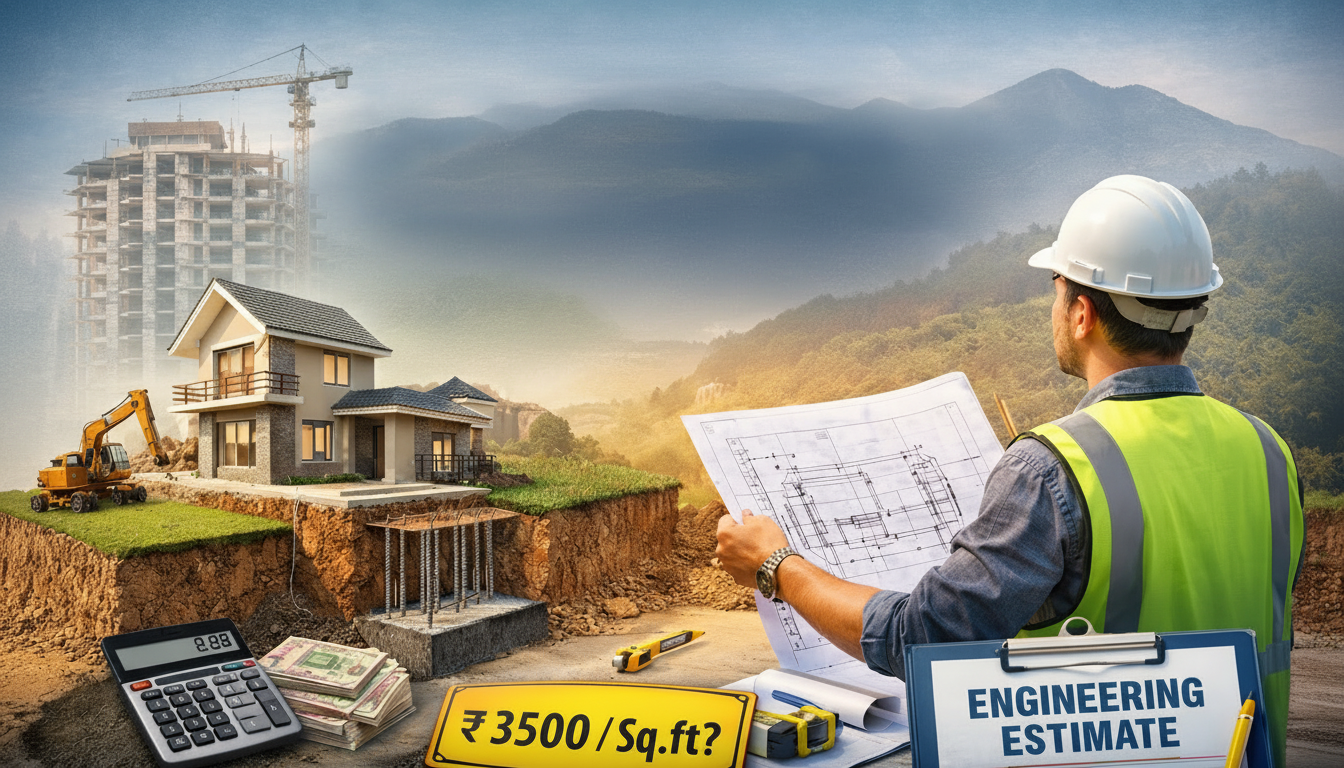
Stop Blindly Trusting “Per Square Foot” Rates: 5 Costly Traps Every Nepali Homeowner Must Avoid
As soon as the thought of building a house in Nepal comes to mind, the first question people ask is: “What is the current running rate per square foot? “Yes house construction cost.
When a contractor or engineer quotes “3,500” or “4,500 per sq. ft.,” most homeowners use that single number to calculate their entire budget. But the real questions are:
- Can a square foot rate alone determine the actual cost of your home?
- Why do two houses with the identical design often end up with different price tags?
Today, we will dive deep into this topic through a real-life case study from Budhanilkantha.
1. Same Design, Two Different Results: A Case Study
In 2020, two friends (let’s call them Mr. A and Mr. B) approached us to build houses with the exact same design in Budhanilkantha.
- Mr. A: 5 Anna plot
- Mr. B: 4.5 Anna plot
- The Scenario: Same blueprints, same maps, and the same material specifications.
Initially, both were given the same tentative rate. However, we set one condition: A mandatory site visit before finalizing the budget.
The Reality Revealed During the Site Visit:
Upon reaching the locations, the differences were stark:
Mr. A’s Land:
- Flat terrain.
- Located right next to a wide road.
- Easy transportation of materials (heavy trucks could reach the gate).
Mr. B’s Land:
- Narrow access road (logistics issue).
- Large tippers could not enter; materials required reloading into smaller vehicles.
- Sloped terrain requiring significant earthwork.
- Need for retaining walls and expensive soil management/dumping.
The Outcome:
Despite having the exact same house design, Mr. B’s project cost 4–5 Lakhs more right from the start.
If they had relied solely on a “square foot rate,” the estimate would have been dangerously wrong, leading to budget overflows or compromises on construction quality midway through the project.
2. Why is a Square Foot Rate Unreliable in House Construction Cost in Nepal?
A square foot rate is merely a rough estimate. The true cost of construction depends on these critical factors:
- Soil Condition & Foundation: Weak soil requires deeper foundations. If the plinth height increases, your costs for steel, cement, and labor rise instantly. Sloped land also necessitates expensive retaining walls.
- Logistics & Transportation: If the road is narrow and large trucks can’t reach the site, you pay extra for manual labor and reloading materials. This significantly bumps up the “per unit” cost.
- Site Access: Can a concrete mixer reach the site? If not, the extra labor required to carry materials increases the budget.
- Finishing Quality: There is a massive price gap between basic tiles and premium tiles, or UPVC versus wooden windows. Finishing can swing the total cost by 20–30%.
- Structural Complexity: Complex designs, multiple floors, or large cantilever structures naturally demand more reinforcement and specialized shuttering.
3. Why the Square Foot Rate is a “Gamble”
Relying on it is risky because it:
- Ignores the actual condition of the site.
- Overlooks logistics and transportation challenges.
- Fails to account for variations in material quality.
- Does not consider sub-surface soil issues.
4. The Right Solution: Engineering BOQ & Detailed Estimation
Before you break ground, you need two things:
- Bill of Quantities (BOQ): A detailed list of every material required.
- Detailed Engineering Estimate: A breakdown of labor and material costs for every stage of work.
This provides a clear picture of how much cement, sand, and steel you need, as well as the stage-wise costs of the project. This is why professional tools like Nirman Sutra Pro are becoming essential for modern homeowners. Explore Engineering Tools at pro.nirmansutra.com
The Hidden Costs in House Construction Cost in Nepal
Most homeowners only look at the cost of bricks, cement, and steel. However, several hidden factors can quickly inflate your house construction cost in Nepal if not planned properly:
- Municipal & Legal Fees: The cost of building permit (Naxa Pass), revenue, and designer fees are often ignored in the initial budget.
- Temporary Site Works: Setting up a temporary shed for cement storage, arranging a water source, and temporary electricity connections for the construction crew add up significantly.
- Compound Wall & Landscaping: Often, the estimate only covers the main structure. Compound walls, gates, and external paving can add an extra 10–15% to your total house construction cost in Nepal.
- Contingency for Price Hikes: Construction materials are subject to market volatility. A 5% price hike in steel or cement mid-project can disrupt your entire financial plan.
Using a detailed BOQ ensures that these “invisible” expenses are captured early, saving you from financial stress later on.
5. Essential Tips for Building a House in 2026
- Never accept an estimate without a site visit.
- Don’t make financial decisions based solely on sq. ft. rates.
- Always demand a BOQ along with a detailed engineering estimate.
- Keep a 5–10% contingency budget for unforeseen expenses.
- Consult an experienced engineer before signing any contracts.
- Plan your logistics (where will the sand stay? can the truck turn?) before starting.
⚠️ Don’t Stop at Just the Budget! Knowing the cost is only half the battle. To ensure your investment is safe, you must avoid common legal traps. Read our guide on: House Construction Agreement: 7 Costly Mistakes to Avoid in 2026.
Conclusion
Building a home is one of the biggest investments of your life. It is wiser to trust engineering-based detailed estimation rather than a “guesswork” square foot rate.
Accurate Information = Right Decisions Accurate Estimates = Secure Investment
Do you have a question? What is the condition of your land? Has someone given you a “fixed rate” estimate recently? Leave your questions in the comments below-our technical team is here to help!
House Construction Cost in Nepal: Frequently Asked Questions (FAQ)
.
1: What is the average house construction cost in Nepal in 2026?
The average house construction cost in Nepal currently ranges from NPR 3,500 to NPR 4,500 per square foot for a standard residential building. However, this cost can fluctuate based on location and the quality of finishing materials used.
2: Why is a square foot rate unreliable for determining house construction cost?
A square foot rate is only a rough estimate; actual house construction cost in Nepal depends on specific soil conditions, road access, and logistics, which are not covered in a flat rate.
3: How can I get an accurate house construction cost in Nepal before starting?
To get a precise budget, you should use professional engineering tools like pro.nirmansutra.com to generate a detailed Bill of Quantities (BOQ) and engineering estimate.
4: Does the road size affect the house construction cost in Nepal?
Yes, narrow roads significantly increase house construction cost in Nepal because materials often need to be reloaded into smaller vehicles, adding labor and extra transportation fees.
5: How much contingency budget should I keep for my house construction cost?
It is highly recommended to keep a 5–10% contingency fund above your estimated house construction cost in Nepal to cover any unforeseen site expenses.
1 thought on “House Construction Cost in Nepal: 5 Dangerous Square Foot Traps (2026 Guide)”