
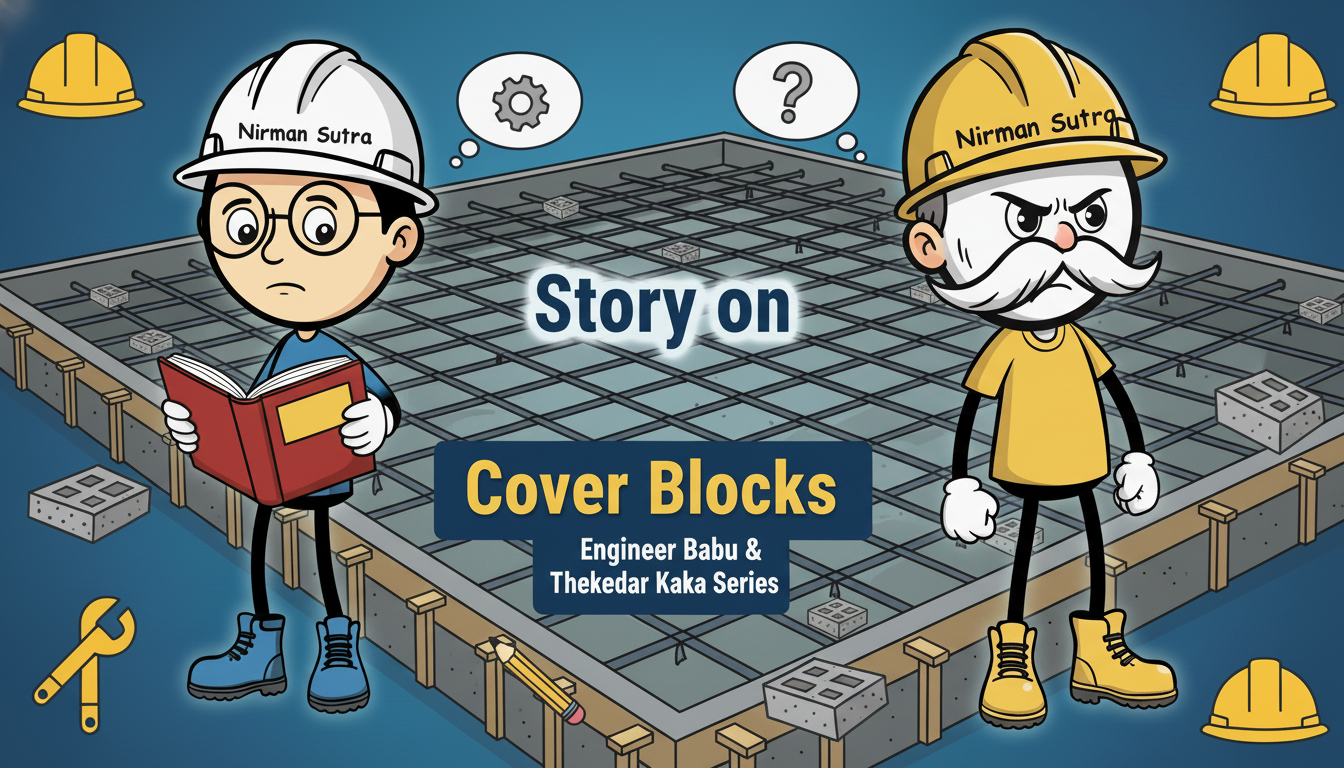
Why Do We Need Cover Blocks in Slab Concreting?
One fine morning, Engineer Babu arrived at the site where the slab formwork was almost ready. The steel reinforcement (rebar) was neatly tied and placed. Contractor Kaka was busy supervising the laborers.
Babu: Kaka, everything looks good, but I don’t see any cover blocks under the reinforcement. Have you placed them?
Kaka: (laughing) Cover blocks? Babu, in my 20 years of experience, many people pour concrete without them and the building still stands. Why waste time and money on these small pieces? The rebar is already tied properly. Once we pour the concrete, it will cover everything.
Babu: (smiling but firm) Kaka, this is exactly where many people go wrong. Let me tell you the real story behind cover blocks. It’s not just a “small thing” – it’s one of those hidden factors that decide whether your building will last 50 years or start cracking and rusting in 10–15 years.
Kaka looked curious. He sat down on a pile of bricks and said, “Okay, explain it to me properly. What’s the big deal?”
Babu: Alright, listen carefully.
The concrete cover is the distance between the outer surface of the concrete, and the steel reinforcement bars inside it. According to structural design codes (like IS 456 in many places, or our Nepali standards), we need a specific minimum cover – usually 20mm to 25mm or more for slabs, depending on the environment and exposure.
Cover blocks (those small concrete or PVC spacers) are used to maintain this exact distance. Without them, when you pour concrete and vibrate it, the heavy rebar often sinks down or shifts towards the bottom or sides of the formwork.
What happens if there’s no proper cover? Here’s the shocking truth:
- Steel touches the surface or gets too close – When the rebar is exposed or has very little concrete cover, moisture, water, and air can easily reach the steel. This causes rusting (corrosion). Rust expands and cracks the concrete from inside. Over time, you see those ugly cracks on ceilings and beams.
- Reduced structural strength – Proper cover helps the concrete and steel work together as a team (composite action). If the cover is insufficient, the bond weakens, and the slab or beam can’t carry the designed load properly.
- Fire safety issue – In case of fire, concrete acts as a protective shield for the steel. Without enough cover, the steel heats up quickly and loses its strength, which can lead to sudden collapse.
- Durability in harsh conditions — In Nepal’s climate — with rain, humidity, and sometimes aggressive soil or pollution – insufficient cover makes the structure weak much faster.
Kaka: (nodding thoughtfully) I have seen many old houses where the ceiling plaster falls off and you can see rusted steel. So this is the reason?
Babu: Exactly, Kaka! Many contractors skip cover blocks to save a little time or cost, thinking “it will be fine.” But years later, the owner pays a heavy price in repairs and safety risks. Using proper cover blocks is a small investment that gives huge returns in the long run.
Kaka: So what’s the right way to do it?
Babu:
- Use concrete cover blocks (same mix as the structure) or good-quality PVC ones.
- Place them at regular intervals – roughly every 1 meter in both directions for slabs.
- Make sure they are fixed properly so they don’t move during concreting and vibration.
- For slabs, bottom cover is critical. Also check side and top cover where needed.
Kaka smiled and immediately called his laborers: “Bring the cover blocks we kept aside. Today we do it the right way, Babu’s style!”
Babu: (laughing) That’s the spirit, Kaka! Small things done right make a strong and durable building.
Moral of the story: Never underestimate cover blocks in RCC (reinforced cement concrete) work. They may look like tiny, insignificant pieces, but they protect your entire structure from corrosion, fire, and early damage. Cutting corners here is like inviting future headaches.
If you’re building a house, always ask your engineer and contractor about the cover – and make sure they use proper cover blocks.
Stay tuned for the next part of Engineer Babu and Contractor Kaka series, where we uncover more practical construction truths!
If you enjoyed this story between Engineer Babu and Contractor Kaka, you’ll love the earlier episodes too! Here are the first three parts of the series:
- Construction Site Measurement Mistakes in Nepal: The 3125 mm Blunder Every Fresh Engineer Makes → Read here: https://blog.nirmansutra.com/english/construction-site-measurement-mistakes/
- 12 Common House Construction Mistakes People Make When Building a House in Nepal → Read here: https://blog.nirmansutra.com/english/house-construction-mistakes-nepal/
- Don’t Make These 7 Mistakes While Plastering a New House | Complete Guide to Prevent Plaster Cracks → Read here: https://blog.nirmansutra.com/english/guide-to-prevent-plaster-cracks/
Useful Tools for Accurate Calculations
While reading these stories, you might want to calculate quantities quickly and correctly. Here are some handy free tools from Nirman Sutra:
- Concrete Calculator for Slab, Beam, Column & More Calculate exact concrete volume, cement, sand, and aggregate for slabs, beams, columns, footings, and other RCC members. → Try it here: https://tools.nirmansutra.com/concrete-calculator/ (or explore all calculators at https://tools.nirmansutra.com/)
- Complete Professional House Estimation Get a full, detailed cost estimate and material list for your entire house (highly recommended before starting construction). → Visit: https://pro.nirmansutra.com
These tools are made especially for Nepali construction practices and help avoid common mistakes that Babu and Kaka often discuss.
Have you faced any of these issues on your own site? Which part of the series did you like the most? Let me know in the comments below!
Stay tuned for the next episode of Engineer Babu and Contractor Kaka — more practical truths coming soon.
FAQs
1. Why are cover blocks so important in slab, beam, and column construction?
Cover blocks maintain the required concrete cover over the steel reinforcement. Without proper cover, the steel can rust easily, leading to cracks, reduced strength, and expensive repairs later. Good cover also improves fire resistance and overall durability of the house.
2. What is the correct size of cover blocks for slabs in Nepal?
For normal house slabs in Nepal, the standard concrete cover is usually 20 mm to 25 mm at the bottom. For beams and columns, it is generally 25 mm to 40 mm depending on the exposure condition and structural design. Always follow your structural engineer’s recommendation.
3. Can we pour concrete without using cover blocks?
Technically yes, but it is highly risky. Many old houses in Nepal are now suffering from rusting steel and ceiling cracks because cover blocks were skipped to save time or money. Using proper cover blocks is a small effort that greatly increases the life and safety of your building.