
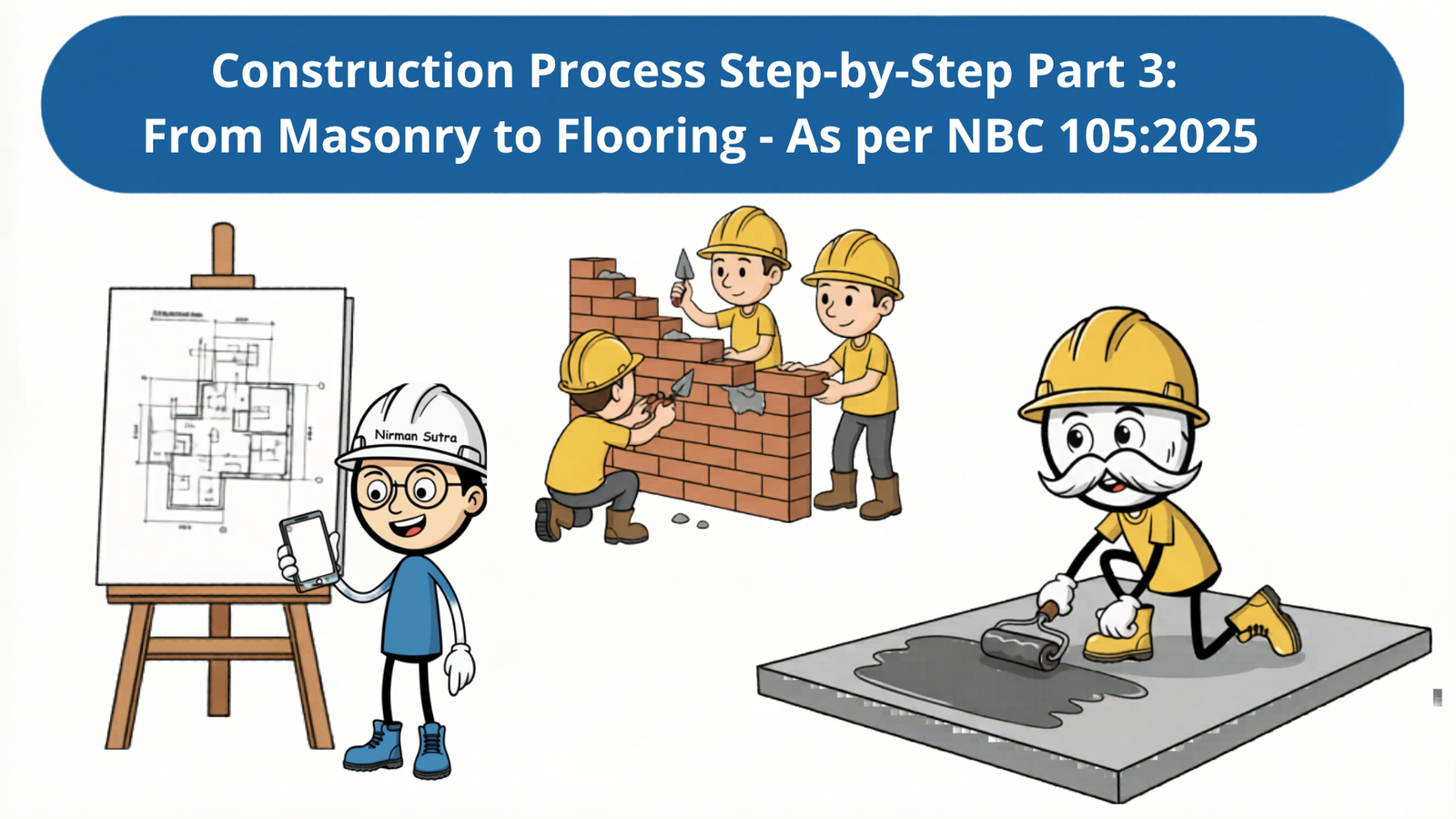
Crack Free Home: Construction Process Step-by-Step Part 3
It’s a sunny afternoon on the construction site. Contractor Kaka is carefully checking the plumb of a newly built brick wall. Engineer Babu arrives carrying the Plumbing Layout Drawing.
“Babu, Steps 5–8 (Structural & Superstructure) are completed. Now we are entering Part 3 – Steps 9 to 12. This is the phase where we build the actual ‘Body’ of the house. You give me the technical planning side, and I will show you the hands-on construction methods, common mistakes, and correct procedures.”
Kaka smiles and says, “Babu, now that the structure is ready, it’s time for walls, roof, pipes, and plaster. Even a small mistake in this phase can cause leakage, cracks, or moisture problems. Today, I will show you how things are actually done on site. According to NBC 105:2025, earthquake-resistant wall ties are also very important. Come, let’s start Episode 16.”
In this episode, we bring you Construction Process Step-by-Step Part 3. Out of the total 16 steps, here are Steps 9 to 12:
- Step 9: Masonry & Wall Construction
- Step 10: Roofing & Waterproofing
- Step 11: Electrical, Plumbing & HVAC Rough-in
- Step 12: Plastering & Flooring Work
Engineer Babu explains the technical planning as per NBC/IS Codes, while Contractor Kaka shares practical on-site construction tips, material selection, and quality control. This guide is based on the 2026 Nepal market and NBC 105:2025.
Step 9: Masonry & Wall Construction: Crack free home
The walls in a house not only divide the rooms but also protect the building from the external environment and provide stability to the frame during an earthquake. According to Nepal’s National Building Code (NBC 105:2020/2025), the following points should be considered while doing masonry work.
Babu’s Technical Planning (The Engineering Perspective)
From an engineering point of view, a wall is a load-bearing unit.
Material Selection:
- Clay Bricks: Traditional and good for thermal control, but heavy, which increases seismic weight.
- Cement Blocks: Faster to construct and more economical.
- AAC Blocks (Autoclaved Aerated Concrete): Modern, lightweight, reduces earthquake damage, and keeps the house cooler.
Mortar Ratio:
- 9-inch load-bearing walls: 1:6 (1 part cement : 6 parts sand)
- 4 or 5-inch partition walls: 1:4
Technical Connections: It is mandatory to use Wall Ties or Starter Bars between the wall and column. This prevents the wall from separating from the column during an earthquake. Bands must be provided above windows and doors to prevent cracks at corners.
Kaka’s Practical Experience (Construction Reality)
- Soaking Bricks: Dry bricks absorb water from the mortar, making it weak. Soak bricks in water for at least 2 hours before use.
- Plumb & Level: Check plumb and level in every layer. Even a slight tilt can make the entire house unbalanced.
- Daily Height Limit: Do not build more than 1.2–1.5 meters height in a single day.
- Running Bond Pattern: Vertical joints should not come one above the other.
- Gap with Beam: Leave a 20–25 mm gap between the top of the wall and the beam, then fill with mortar later. This gives flexibility during earthquakes.
Masonry Calculations
Number of Bricks: N=Vbrick with mortarVwall
In Nepal, approximately 500 bricks (with mortar) are required per cubic meter of wall.
Dry Volume of Mortar: Dry Volume=1.33×(Wet Volume of Mortar)
Step 10: Roofing & Waterproofing
Babu’s Planning: “The roof slab must bear load and be completely water-tight. Provide a positive slope (minimum 1:80) as per NBC. Waterproofing methods: Bitumen, Cementitious Coating, Liquid Membrane, or APP/SBS Sheet. For heat insulation: EPS/XPS Board or Brick Bat Coba.”
Kaka’s Hands-on Construction: “After casting the slab, curing is most important.
Step-by-Step Process:
- Start curing within 4-6 hours of slab casting (Water Ponding Method for 14 days).
- Clean the surface and fill cracks.
- Apply primer + waterproofing material (extra at corners and pipe junctions).
- Lay insulation layer and slope screed.
- Final protection layer (tile or screed).
I have seen many houses leaking during monsoon just because of poor curing. Now I do 14 days of ponding and a 24–48 hour water test before proceeding.”
Step 11: Electrical, Plumbing & HVAC Rough-in
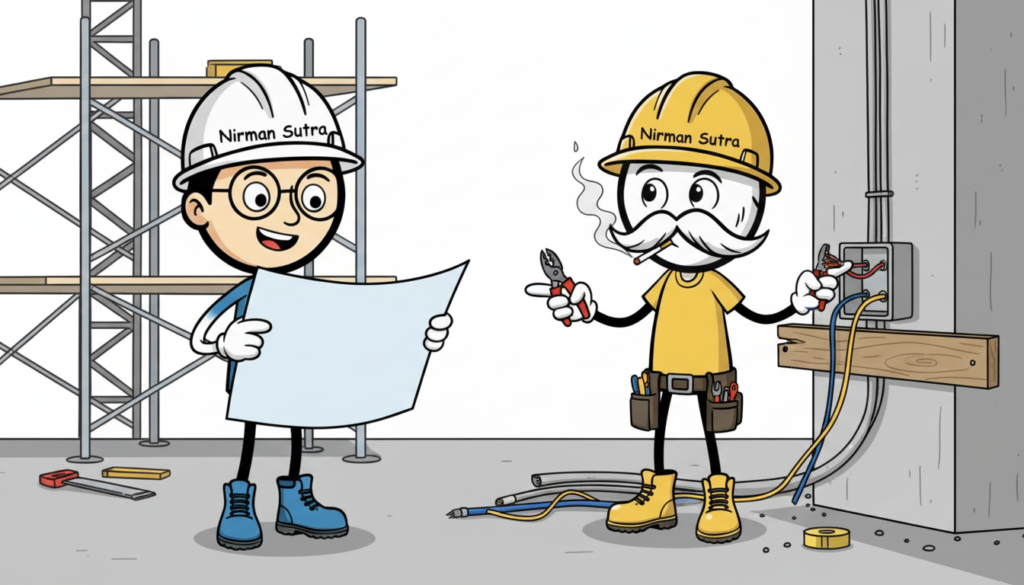
Babu’s Technical Planning: Use concealed systems for a clean look. Proper load calculation, separate circuits, ELCB/RCCB, color-coded wires, CPVC/PPR pipes, correct slopes (1:40–1:60), P-Traps, and pressure testing are mandatory.
Kaka’s Practical Tips: “Embed conduits and pipes in walls and slabs before plastering — it becomes very expensive later. Always do pressure testing (1.5 times) before covering.”
Step 12: Plastering & Flooring Work
Babu’s Planning:
- External Plaster: 1:4
- Internal Plaster: 1:5
- Flooring: Vitrified tiles (common), Marble/Granite (premium)
Kaka’s Method: Apply plaster in two coats (12–15mm + 6–8mm) with proper curing for 7 days. For flooring, prepare a level base and use uniform grout spacing.
Common Mistakes to Avoid in Steps 9–12:
- Not tying wall to column → High earthquake risk
- Inadequate curing → Cracks & leakage
- Wrong plumbing slope → Blockage & backflow
- Poor plaster bonding → Peeling & hollow sound
Conclusion:
Kaka says at the end, “Babu, Steps 9–12 are where the house actually becomes a proper home. Good planning and careful construction are the only way to get good results.”
Babu: “In the next episode, we will cover the final part — Steps 13 to 16 (Painting to Handover).” and if you want to read previous click here.